Types of Bees: A Field Guide to the Bees in Your Yard
Honey Garage is reader-supported. As an Amazon Associate we earn from qualifying purchases, at no extra cost to you. Read our affiliate disclosure.
There are about 20,000 known types of bees in the world, and roughly 4,000 of them are native to North America. Most people only ever notice a handful: honey bees, bumble bees, carpenter bees, mason bees, leafcutter bees, sweat bees and mining bees. You can tell them apart by size, color, how hairy they are, where they nest and how they behave when you get close.
This guide walks through each one, then covers the wasps and flies that get mistaken for bees. There is a quick identification table further down if you just want to put a name to the insect on your flowers.
Social bees and solitary bees
Before looking at individual bees, it helps to know that bees fall into two broad lifestyles.
- Social bees live in colonies with a queen and workers. Honey bees and bumble bees are the familiar examples. Because they have a nest full of brood and food to protect, they are the ones most likely to sting in defense.
- Solitary bees make up the large majority of species. Each female builds her own nest, stocks it with pollen and nectar, lays her eggs and leaves. There are no workers and no hive to defend, so solitary bees are very gentle.
Nesting splits them another way. In North America about 70% of native bees nest in the ground, and about 30% nest in cavities such as hollow stems, beetle holes or wood. You can read more about these wild species in our guide to raising solitary bees.
The common types of bees
Honey bees
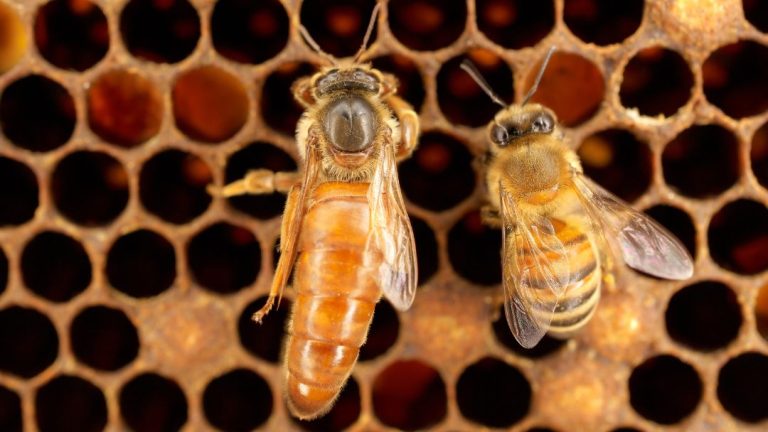
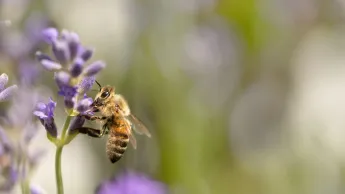
Honey bees are about half an inch long, slim, and golden brown to dark brown with darker bands on the abdomen. They are fuzzy on the thorax but much less hairy than a bumble bee. Look at the hind legs of a returning forager and you will often see a packed ball of pollen in a “pollen basket”.
They live in colonies of tens of thousands, in hives or in hollow trees and wall cavities, and they are not native to the Americas; European settlers brought them over in the early 1600s. A worker’s barbed stinger stays in your skin and the bee dies, so honey bees sting only when defending the colony or when trapped. Beekeepers choose between several species and strains, from Italians to Carniolans, which we compare in our guide to types of honey bees.
Bumble bees
Bumble bees are the big, round, very hairy bees with bands of black and yellow, and in some species orange or white. Queens can be close to an inch long. About 250 species exist worldwide, with around 46 in North America.
Their colonies are small, from a few dozen to a few hundred bees, and they last only one season. The old colony dies in fall and only newly mated queens survive the winter. Nests are usually in the ground, often in old rodent burrows, or in grass tussocks and compost heaps. Bumble bees are placid on flowers but will defend a nest, and unlike honey bees they can sting more than once.
Carpenter bees
Large carpenter bees look like bumble bees at first glance. The quick check is the abdomen: a carpenter bee’s is shiny, black and almost hairless, while a bumble bee’s is fuzzy all over.
Females chew perfectly round, half-inch holes into bare or weathered wood such as fascia boards, decks and eaves, and lay eggs in tunnels inside. You may see sawdust below the hole. Males often hover in front of people and dart at them, which looks aggressive, but males have no stinger at all. In the common eastern species, males have a pale yellow patch on the face. Females can sting but rarely do unless handled.
Mason bees
Mason bees are small, from about the size of a house fly to a little larger, and many North American species are a dark, metallic blue or blue-green. The best known is the blue orchard bee, a spring bee that is an excellent fruit tree pollinator.
They nest in existing holes, including hollow stems and the tubes of a bee house, and seal each cell with mud, which is where the name comes from. They carry pollen on hairs under the abdomen rather than on the legs. Mason bees are about as gentle as bees get and will sting only if squeezed. Our guide to attracting mason bees shows how to bring them into your garden.
Leafcutter bees
Leafcutter bees are similar in size to a honey bee but stockier, dark gray to black, with pale bands on the abdomen. The easiest way to spot them is by the damage: neat, round or oval cutouts along the edges of rose, lilac or redbud leaves. The females roll these pieces into cigar-shaped cells inside hollow stems or tunnels.
Like mason bees, they carry pollen on the underside of the abdomen, which often looks bright yellow when loaded, and they fly in summer rather than spring. They sting only mildly and rarely. See our tips for mason and leafcutter bees for nesting setups that suit both.
Sweat bees
Sweat bees are small to tiny, often a quarter inch or less. Some are dull black or brown, but many are a brilliant metallic green, and a few have a green head and thorax with a striped abdomen. They get their name from landing on people to lick salt from sweat on hot days.
Most nest in the ground. A sweat bee sting is mild and usually happens only when one gets pressed against your skin, for example under a shirt collar.
Mining bees
Mining bees are among the first bees out in early spring. They are honey bee sized or smaller, dark, and fairly hairy, often with pale hair on the thorax. Many have a fuzzy patch on the face.
You usually notice them by their nests: dozens of small volcano-shaped mounds of soil in bare or thinly grassed patches of lawn. Each mound belongs to one female, even when hundreds nest side by side. They are harmless, rarely sting, and are gone within a few weeks. There is no need to treat a lawn for them. More on ground nests in bees that nest in the ground.
Bee identification table
| Bee | Size | Color and hair | Nest | Sting behavior |
|---|---|---|---|---|
| Honey bee | About 1/2 in | Golden to dark brown, banded; moderately fuzzy | Hives, hollow trees, wall cavities | Defends colony; barbed sting, stings once |
| Bumble bee | 1/2–1 in | Black and yellow, sometimes orange; very hairy all over | Ground, old burrows, grass | Defends nest; can sting repeatedly |
| Carpenter bee | 3/4–1 in | Black and yellow thorax; shiny, bare black abdomen | Tunnels in bare wood | Males cannot sting; females rarely do |
| Mason bee | 1/4–1/2 in | Metallic blue or blue-green; pollen under abdomen | Hollow stems, bee houses, sealed with mud | Very gentle |
| Leafcutter bee | About 1/2 in | Dark gray with pale bands; yellow pollen under abdomen | Hollow stems, lined with leaf pieces | Mild, rare |
| Sweat bee | 1/8–1/2 in | Black, brown or bright metallic green | Mostly in the ground | Mild, only when pressed |
| Mining bee | 1/4–1/2 in | Dark, hairy, often pale thorax hair | Small soil mounds in lawns | Very gentle |
Wasps and flies people mistake for bees
Many “bee stings” at picnics are actually wasp stings. Wasps are mostly hunters and scavengers, so they tend to be smooth and shiny rather than fuzzy, with a narrow waist and legs that dangle in flight.
- Yellowjackets. Bright yellow and black, about honey bee length but smooth and shiny. They nest in the ground or in wall voids and come to sugary drinks and meat in late summer. They can sting repeatedly and defend their nests hard. They also raid beehives; see protecting honey bees from yellow jackets.
- Paper wasps. Long and slender with long dangling legs, brown or black with yellow or red markings. They build open, umbrella-shaped paper combs under eaves and deck rails.
- Hornets. Larger than yellowjackets. The bald-faced hornet (technically a yellowjacket) is black and white and builds football-sized gray paper nests in trees. The European hornet is brown and yellow and nests in hollow trees.
- Hover flies. Striped yellow and black like bees, but they hover in place, have one pair of wings instead of two, very large eyes and short stubby antennae. They cannot sting.
A quick rule of thumb: fuzzy and carrying pollen usually means bee; smooth, shiny and interested in your lunch usually means wasp.
What to do about stings
Most bees in the list above will never sting you if you leave them alone. If a honey bee does, scrape the stinger out quickly, since it keeps pumping venom for a short time. Swelling and itching around the sting are normal. Hives or swelling away from the sting site, trouble breathing, or dizziness are signs of an allergic reaction and need emergency care. If you have reacted badly before, talk to a doctor about allergy testing. Our guide to bee stings covers this in more detail.
Frequently asked questions
How many types of bees are there?
Scientists have described about 20,000 bee species worldwide, and new ones are still being found. Roughly 4,000 are native to North America. Only a small number of those are honey bees; the vast majority are solitary wild bees.
What is the most common type of bee?
In most gardens and farms the bee you see most often is the honey bee, because a single colony sends out thousands of foragers. By number of species, though, ground-nesting solitary bees such as sweat bees and mining bees are far more common.
Which bees do not sting?
Male bees of every species have no stinger, since the stinger is a modified egg-laying organ. Among females, mason, mining and leafcutter bees are so gentle they almost never sting. Stingless bees do exist, but they live in the tropics, not in North America.
How can I tell a bumble bee from a carpenter bee?
Look at the abdomen. A bumble bee is hairy all over, including the rear half. A carpenter bee has a shiny, bare, black abdomen. Carpenter bees also hang around wooden structures, while bumble bees nest in the ground.
Which bees make honey?
Honey bees are the only bees that store honey in quantities worth harvesting. Bumble bees keep small amounts of nectar in wax pots, and some tropical stingless bees make honey too. Solitary bees do not make honey at all; they feed their young a ball of pollen and nectar.
If watching the bees in your yard has you thinking about keeping a colony of your own, our bee care section is a good place to start.