Best Carpenter Bee Traps (Plus Baits and How to Stop the Damage)
Honey Garage is reader-supported. As an Amazon Associate we earn from qualifying purchases, at no extra cost to you. Read our affiliate disclosure.
A carpenter bee trap is a wooden block with angled holes that look like a perfect nesting tunnel. Bees crawl in, find it dark, and drop down toward the light into a jar or chamber they cannot climb out of. The best carpenter bee trap for most homes is a solid wood block with a clear or glass receptacle, hung right beside the active holes in early spring. A trap reduces the number of bees drilling your deck or eaves. It works best with a little bait, and you need to seal bare wood so new bees do not move in.
Our picks at a glance
| Product | Best for | Key feature |
|---|---|---|
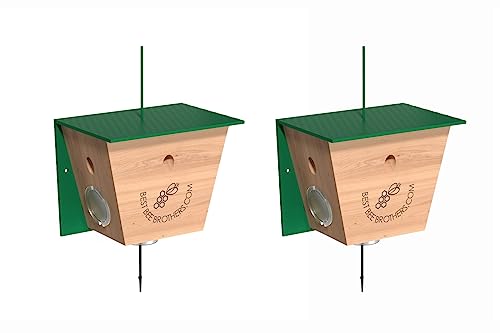
| Best Bee Brothers Turbo Trap 2.0 (2-pack) | Best overall | Four-chamber funnel, bait cup, empties by pull cord while hanging |
| Best Bee Brothers Ultimate Pro (2-pack) | No-touch emptying, big catches | Internal vault plus an XL clear receptacle and spring-loaded door |
| Bee Warehouse Carpenter Bee Trap | Catch and release | Latch on the catch chamber so bees can be relocated; comes with hole plugs |
| Original B Brothers Wooden Catcher | Classic jar trap | Solid wood block with a mason-style glass jar and hanging chain |
| Billy Bob Carpenter Bee Trap | Made in the USA | Solid wood top, unscrew the mason jar to empty |
| Best Bee Brothers Bee-Licious Lure | Bait for traps with a bait cup | Contains dried carpenter bees; a dime-size dab per trap |
| Donaldson Farms Carpenter Bee Attractant | Bait for any trap, including homemade | 2 oz bottle, made in the USA |
Is it a carpenter bee or a bumble bee?
Check before you trap. Carpenter bees and bumble bees are about the same size and both are black and yellow, but only carpenter bees bore into wood. The quickest test is the abdomen: shiny and almost bare on a carpenter bee, fuzzy on a bumble bee.
| Carpenter bee | Bumble bee | |
|---|---|---|
| Abdomen | Shiny black, mostly hairless | Covered in dense hair, often with yellow bands |
| Size | About 3/4–1 in | Varies; queens up to about 1 in |
| Nest | Tunnels drilled in bare or weathered wood | In the ground, old rodent holes, compost or thick grass |
| Signs | Perfectly round holes about 1/2 in wide, with sawdust below | Bees going in and out of a hole in the ground or a tussock |
| Behavior | Males hover and dart at people near the nest | Busy on flowers, rarely bother anyone |
| Social? | Solitary; each female makes her own tunnel | Social colony with a queen and workers |
In the eastern carpenter bee, males have a pale yellowish-white patch on the face and females have an all-black face. Males are the ones that hover in your face, but they have no stinger. More on telling bees apart in the types of bees.
The best carpenter bee traps and baits
1. Best Bee Brothers Turbo Trap 2.0 (best overall)
The Turbo Trap 2.0 is Best Bee Brothers’ updated wooden trap, sold as a 2-pack so you can cover two problem spots. Inside, a four-chamber funnel leads bees down into what the maker calls the Bee Vault, and a side viewing window shows you how full it is. The maker says it holds about 20% more than their original trap and draws bees from up to 15 ft away.
Emptying is the clever part. A spring-loaded bottom door opens with a 9 ft pull cord, so you can empty it while it is still hanging, or clear it with a vacuum hose. It measures 5.9 x 4.1 x 4.8 in, has two pre-drilled roof holes for hanging, and a built-in bait cup. Bait is sold separately.
- Good: 2-pack, empty without taking it down, viewing window, bait cup
- Watch for: Bait not included; range claims are the maker’s own
2. Best Bee Brothers Ultimate Pro (best for no-touch emptying)
The Ultimate Pro pairs an internal Bee Vault with an extra-large clear external receptacle, so it can hold a big catch before you need to deal with it. The receptacle is aerated, and there is an integrated bait cup. Like the Turbo Trap, it is purely mechanical, with no chemicals.
A spring-loaded release door and a 9 ft pull string let you drop the catch out without touching the bees or taking the trap down. It comes as a 2-pack in green and measures 4.2 x 5.8 x 7.5 in. The maker claims a 15 ft radius. Choose this over the Turbo Trap if you have a lot of carpenter bees and want the bigger receptacle.
- Good: XL clear receptacle, no-touch release door, 2-pack, chemical-free
- Watch for: Larger and more visible than a plain wooden block; bait sold separately
3. Bee Warehouse Carpenter Bee Trap (best for catch and release)
Bee Warehouse’s trap is a wooden block with pre-drilled holes over an extra-large catch chamber. Its standout feature is a catch-and-release latch on the chamber, so you can take trapped bees away and let them go rather than kill them. The maker says the chamber usually only needs emptying once a year and gives a range of 5–15 ft.
The Bee Warehouse trap comes with hanging hardware and five “bee dams”, plugs for sealing old carpenter bee holes once the bees have gone. That makes it a good choice if you want to deal with carpenter bees without killing them and fix the damage at the same time. The design is patented. Take released bees well away from your house before you let them go.
- Good: Catch-and-release latch, large chamber, includes hole plugs and hardware
- Watch for: Released bees need to go well away from your house or they may return
4. Original B Brothers Wooden Carpenter Bee Catcher (best classic jar trap)
This is the classic design: a solid wood block with angled holes, sitting on a mason-style glass jar. The glass lets in the light that draws bees down, and you can see at a glance when it needs emptying. It is spray-free and made by a woman-owned brand, and the design is patented.
Screw hooks and a hanging chain are included, so it is ready to hang out of the box. It is a single trap, which suits one problem area such as a deck railing or a corner of the eaves; buy two or more if you have holes around the house.
- Good: Simple, proven block-and-jar design, glass jar, chain and hooks included
- Watch for: Single trap only; no bait cup
5. Billy Bob Carpenter Bee Trap (best made in the USA)
Billy Bob’s trap is made in the USA, with a solid wood top and a mason jar underneath, using the same patented block-and-jar principle as other wooden traps. To empty it, you simply unscrew the jar, tip out the catch and screw it back on. It measures 3.5 x 3.5 x 9 in, so it is compact enough to tuck under an eave or hang from a deck rail.
The maker’s tip is a good one for any jar trap: leave a few dead bees in the jar after emptying, because their scent attracts other carpenter bees. It is a newer listing with far fewer reviews than the Best Bee Brothers and B Brothers traps, so it has less of a track record.
- Good: Made in the USA, solid wood, unscrew jar to empty
- Watch for: Few reviews yet; single trap
6. Best Bee Brothers Bee-Licious Lure (best bait for traps with a bait cup)
Bee-Licious is a carpenter bee lure from Best Bee Brothers that contains dried carpenter bees, so it carries their real scent. You put a dime-size dab in the trap’s bait cup and reapply according to the directions on the pack. It comes in a 10 mL container, which goes a long way at that dose if you only run a few traps.
It is made for Best Bee Brothers traps with a bait cup, but a dab inside a hole of any wooden trap works the same way. Bait is most useful on a new trap that does not yet smell of bees, and in early spring when you want catches to start quickly.
- Good: Real carpenter bee scent, tiny dose per trap
- Watch for: Small 10 mL size; needs reapplying through the season
7. Donaldson Farms Carpenter Bee Attractant (best bait for any trap)
Donaldson Farms’ carpenter bee attractant comes in a 2 oz bottle and is made in the USA. The maker says it works with any carpenter bee trap, including a homemade one, which makes it the obvious pick if you built your own trap from a block of 4×4 or own a trap without a bait cup. A small amount inside one of the entry holes is enough.
The maker also says it is gentle on honey bees, which matters if you keep bees or have neighbors who do. Even so, hang baited traps well away from your hives and apply only as much as the label directs. Carpenter bees are drawn by nest scent, so there is no benefit in soaking the trap; more bait mostly means you run out sooner.
- Good: Works in any trap including DIY, larger 2 oz bottle, made in the USA
- Watch for: The honey-bee-safe claim is the maker’s; keep traps away from hives anyway
How carpenter bee traps work
A carpenter bee looking for a nest wants a round hole about 1/2 in wide in solid wood. A trap gives her several: holes drilled at an upward angle into the sides of a wooden block, meeting a central cavity. Inside it is dark, except for light coming up from the jar or clear receptacle underneath. The bee heads for the light, drops into the container, and cannot find her way back up the angled tunnel.
There is no poison and no power. Some designs add funnels or an inner “vault” to make escape even harder, and a bait cup for a scent lure. Most traps also have a roof or a lip, because rain in the jar drowns the catch into a smelly soup.
What to look for in a carpenter bee trap
- Real wood. Bees are looking for wood, so a solid, untreated block works better than plastic. Weathered wood often catches better than bright new wood.
- A clear or glass receptacle. The light drawing bees down is what makes the trap work. It also lets you see when to empty it.
- Easy emptying. A screw-off jar is simple. A spring-loaded door with a pull cord lets you empty the trap without taking it down.
- A bait cup, if you plan to use a lure. Otherwise a few dead bees left in the jar do a similar job.
- Hanging hardware. Hooks or a chain save you a trip to the hardware store.
- How many you need. One trap per problem area is a good start: one at each corner of the house, deck or shed that has holes. That is why the 2-packs are good value.
Where and when to hang a carpenter bee trap
- Timing: hang traps in early spring, before or as carpenter bees emerge. In most of the US that is April–May, a little earlier in the South. That is when adults leave their overwintering tunnels, mate and look for nest sites. A second, smaller flush of young adults appears in late summer.
- Location: as close as you can to the active holes, within a few feet, and in the same sunny spot. Under eaves, at the corners of the house, on deck posts and railings, and on fascia boards and sheds are the usual places.
- Height: near the height of the damage. Carpenter bees fly along the wood where they are drilling, so a trap on the ground far from the holes catches little.
- Hang it freely so the jar is clear and gets light.
- Be patient. Catches can take a week or two to start. If a trap catches nothing after a few weeks, move it closer to the holes.
Bee trap bait: do you need it?
A trap works without bait, because the holes themselves are the attraction. Bait helps a new trap start catching sooner, especially one that is brand new and does not yet smell of bees. Carpenter bee baits use the scent of other carpenter bees. Bee-Licious, for example, contains dried carpenter bees.
- Use a small amount. A dab in the bait cup or just inside one of the holes, as the label says. More is not better.
- Reapply as the directions say, usually every few weeks through spring.
- Free bait: leave a few dead carpenter bees in the jar when you empty it. Their scent draws others in.
- Do not use sweet baits like sugar water or fruit juice. Carpenter bees are hunting for a nest, not food, and sugar pulls in honey bees and wasps.
How to make a DIY carpenter bee trap
If you have a drill, a homemade trap takes about half an hour:
- Cut a 6–8 in length of untreated 4×4 lumber.
- Drill a 1/2 in hole on each of the four sides, angled upward at about 45°, a few inches deep.
- Drill a wider hole up into the center of the block from the bottom, so it meets the side holes.
- Screw a mason jar lid to the bottom over the center hole, with a hole cut in the lid, and screw the jar on.
- Add a small scrap-wood roof to keep rain out, and a hook or eye screw on top for hanging.
How to stop carpenter bees coming back
Traps catch bees; prevention stops the damage. Carpenter bees prefer bare, unpainted, weathered softwood such as cedar, pine, redwood and cypress.
- Paint bare wood. A good coat of paint is the best deterrent. Stain and clear sealers help less, but they are better than bare wood. Keep the finish in good repair, because weathered spots get drilled first.
- Plug old holes in fall. Once the season is over, fill each hole so it cannot be reused next spring. Push in a tuft of steel wool, or tap in a glued length of 1/2 in dowel, then seal it over with wood filler or caulk and paint over it. Bees chew back through soft filler alone; the metal or wood plug is what stops them. Adults often spend the winter inside old tunnels, so a fall plug also seals them in. If you would rather let them go, wait until you see them flying in spring, then plug the holes once they have left and moved to a trap.
- Do not ignore it. Females reuse and extend old tunnels year after year, and woodpeckers tear the wood apart to get at the larvae. Much of the real damage comes from years of neglect.
- Consider harder or covered wood for new builds, such as composite decking or metal flashing on exposed fascia ends.
When to use a carpenter bee spray instead
For a few holes in a spot you cannot trap, such as high in a soffit, an insecticide foam sprayed straight into the tunnel works fast. Spectracide Carpenter Bee & Ground-Nesting Yellowjacket Killer is a common foam with an extension tube for this. Follow the label, spray only into the holes, and plug them a day or two later. Never use it near a beehive, near flowering plants, or anywhere honey bees and other pollinators are foraging. For bees nesting in the ground, see ground bee killers.
Before you reach for a spray, remember carpenter bees are native pollinators and rarely dangerous. Males cannot sting at all, and females very rarely sting unless handled or trapped against your skin. If they are drilling a fence post at the back of the garden rather than your house, consider leaving them alone. Why that matters: why pesticide use is bad for bees and other pollinators. If you would rather host friendly wood-nesting bees, a mason bee house is a nice swap.
Frequently asked questions
Do carpenter bee traps really work?
Yes, when hung close to active holes in spring they catch a good share of the bees in the area. They rarely catch every bee, so pair them with painting bare wood and plugging old holes for lasting results.
What is the best bait for a carpenter bee trap?
A scent lure made for carpenter bees, such as Bee-Licious or Donaldson Farms attractant, or simply a few dead carpenter bees left in the jar. Skip sugar and fruit baits; carpenter bees are looking for a nest, not food.
When should I put out carpenter bee traps?
In early spring, as the weather warms and carpenter bees emerge, which is around April–May in most of the US. Leave them up through summer to catch the second group of young adults in August.
Will a carpenter bee trap catch honey bees or bumble bees?
Rarely. Honey bees and bumble bees are not looking for holes in wood, so they are seldom caught. Avoid sweet baits, which can attract honey bees. If you keep bees, hang traps away from your hives.
Do carpenter bees sting?
Males, the ones that hover and dive at you, have no stinger. Females can sting but almost never do unless handled. If you are stung, see our guide to bee stings.
Where do carpenter bees go in winter?
Adults spend the winter inside old tunnels in the wood and come out in spring. That is why plugging holes in fall, and painting in the off season, stops so many bees returning to the same boards.
Dealing with wasps too? See our bee and wasp repellents.