

How to Harvest Honey: When It Is Ready and Step-by-Step Extraction
To harvest honey, wait until frames in the honey super are at least 80% capped with wax, clear the bees off them, slice off the cappings, spin the frames in an extractor (or crush and strain the comb), then strain and bottle the honey. Take only honey stored above the brood nest, and always leave the bees enough to get through winter.
Most beekeepers take their main harvest in mid to late summer, once the big nectar flow ends. A first-year colony often has no surplus at all, so do not be disappointed if your first honey comes in year two. Below is exactly how to tell when honey is ready, what equipment you need, and each step from hive to jar.
When to harvest honey
Honey is ready when the bees say so. They fan nectar until it is dry enough to keep, then seal each cell with a wax cap. Uncapped nectar is too wet and can ferment in the jar.
- Check the capping. A frame is ready when about 80% or more of its cells on both sides are capped. A few open cells at the edges are fine.
- Do the shake test on doubtful frames. Hold the frame flat over the open hive and give it a sharp downward shake. If nectar rains out, it is not ready.
- Measure moisture if you can. A honey refractometer reads water content from a couple of drops. The USDA limit for Grade A honey is 18.6% moisture; aim for 18% or below to be safe from fermentation.
- Time it to the nectar flow. Harvest after a major flow ends, usually mid to late summer in most of the US. Some areas also get a smaller fall crop. See understanding the honey flow.
- Avoid treatment periods. Never put honey supers on, or harvest honey, while using a mite treatment whose label says to remove supers. Follow the label’s waiting period.
Pick a warm, sunny day with bees flying. More foragers are out, the colony is calmer, and warm honey flows out of the comb far more easily.
How much honey to leave for the bees
Honey is the colony’s winter food. Take only surplus from the supers above the queen excluder, and leave the brood boxes’ honey alone. How much the bees need depends heavily on your climate:
| Climate | Honey to leave per colony (approx.) | Roughly equals |
|---|---|---|
| Cold winters (northern US, Canada) | 80–90 lb or more | A full deep box of honey plus stores in the brood box |
| Moderate winters (mid-Atlantic, Midwest south) | 50–60 lb | 7–9 full deep frames |
| Mild winters (Gulf Coast, southern California) | 30–40 lb | 5–6 full deep frames |
A fully capped deep frame holds roughly 6–8 lb of honey and a medium frame about 4–6 lb. Your local beekeeping club knows the right number for your area; when in doubt, leave more. For the bigger question, read is harvesting honey bad for bees? and the ethical harvesting of honey.
Honey harvesting equipment
You can harvest with almost nothing (a knife, a bucket and a strainer), but a few tools make it much faster and let the bees reuse their comb.
| Tool | What it does | Needed? |
|---|---|---|
| Bee escape board or fume board | Clears bees out of the supers before you lift them off | Strongly recommended |
| Smoker, veil, hive tool and bee brush | Opening the hive and brushing off stragglers | Yes |
| Uncapping knife or fork | Slices the wax caps off each frame | Yes, for extraction |
| Uncapping tank or tub | Catches cappings and lets honey drain from them | Helpful |
| Honey extractor | Spins honey out and leaves comb intact | Optional, but worth it past 1–2 hives |
| Double sieve strainer and bucket with honey gate | Removes wax bits; bottles straight from the tap | Yes |
| Refractometer | Checks moisture content | Helpful |
Extractors come as tangential (you flip each frame to do the second side) and radial (both sides at once), hand-crank or electric. Hand-crank 2–4 frame models suit most hobbyists with a few hives; see our best honey extractors and extractor explainer. If you run many hives, a heated knife or one of the honey uncapping machines saves hours.
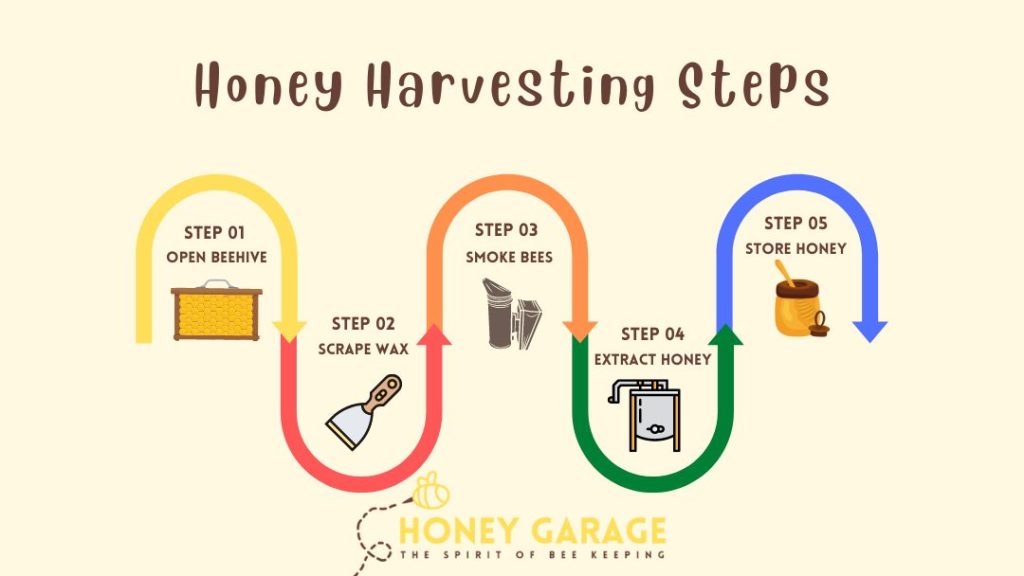
How to harvest honey step by step
1. Clear the bees from the supers
The day before, slide a bee escape board between the brood boxes and the honey supers. Bees can pass down through the one-way escape but struggle to find their way back up, so the supers are mostly empty within about 24–48 hours. A fume board with a bee repellent works in minutes on a warm day. Either way, brush off any stragglers and carry the supers away promptly.
2. Move the supers indoors quickly
Exposed honey triggers robbing within minutes, so cover the boxes and take them into a bee-tight room, shed or kitchen. Keep the room warm, around 80–90 °F if possible, so the honey flows well. Extract within a day or two, especially if you have small hive beetles, which can ruin stored frames fast. Read more on robber bees.
3. Uncap the frames
Stand the frame on end over an uncapping tub. Draw an uncapping knife just under the caps, top to bottom, using a gentle sawing motion. Use an uncapping fork or scratcher for low spots the knife misses. Save the cappings: they drain to a surprising amount of honey and make the cleanest beeswax. See how to harvest beeswax.
4. Extract the honey
Load the uncapped frames so the extractor is balanced (put frames of similar weight opposite each other). Start slowly; spinning full, heavy frames too fast can blow out the comb. In a tangential extractor, spin one side partway, flip, spin the other side fully, then flip back to finish the first. The honey runs down the walls and out through the gate.
No extractor? Cut the comb out, crush it, and let it drip through a strainer, or use a press. This costs the bees their comb, but it is how top bar and many small-scale beekeepers work. See how to harvest honey without an extractor and using a honey press.
5. Strain and settle
Run the honey through a double sieve (coarse over fine) into a food-grade bucket. Cover it and let it stand for a day or two. Air bubbles and fine wax rise to the top, and you can skim them off before bottling.
6. Bottle and store
Fill clean, dry jars from the bucket’s honey gate and seal them tightly. Store honey at room temperature, away from moisture; it keeps for years. It will probably crystallize eventually, which is natural and reversible with gentle warming. See how to bottle honey, how to store honey and why honey crystallizes.
7. Return the wet frames and store supers
Put the sticky, extracted frames back on the hive for a day or two in the evening, and the bees will clean them dry. Then store the supers for winter, protecting the drawn comb from wax moths (freezing frames for a couple of days kills eggs and larvae). See how to store honey supers.
Harvesting comb honey instead
Comb honey skips extraction entirely: you sell or eat the honey still sealed in its wax. It needs a strong colony and a heavy nectar flow, because the bees must build fresh comb as well as fill it. Use thin, unwired foundation (or none) in shallow frames, or purpose-made section equipment, and take the comb as soon as it is fully capped so it stays white and clean. Cut it into squares, drain the cut edges on a rack, and freeze it for a couple of days to kill any wax moth eggs before packing. See the Ross Round comb honey kit and Hogg Halfcomb kit.
Harvesting from different hive types
The steps above suit Langstroth hives, where removable frames go into an extractor. Top bar hives have no frames, so you cut the comb off the bar and crush and strain it, or sell it as cut comb. Warré hives are harvested by removing the top box. Details for each are in how to harvest honey from Langstroth, top bar and Warré hives and top bar hive honey extraction.
Common honey harvesting mistakes
- Taking uncapped frames. Wet honey ferments. Leave them for the bees or check with a refractometer.
- Taking too much. Stripping the brood boxes starves colonies in winter. If you did, feed heavy syrup in early fall; see feeding bees.
- Leaving honey exposed. Spilled honey or open boxes near the apiary start robbing that can destroy weak hives.
- Spinning too fast too soon. Blown-out comb means the bees must rebuild it, which costs them honey.
- Harvesting brood frames. Use a queen excluder so the queen cannot lay in the supers.
Want more honey next year? Read how to get bees to make more honey.
Frequently asked questions
How much honey does one hive produce?
It varies hugely with weather, forage and colony strength. A strong, established colony in a good year often gives 30–60 lb of surplus, sometimes more; a first-year colony may give none. See how often beehives produce honey.
Can you harvest honey in the first year?
Sometimes, but usually not. A new colony spends its first season drawing comb and building winter stores. Only take honey if the colony has already filled its brood boxes and has capped surplus in a super.
What month do you harvest honey?
In most of the US, July to September, after the main summer flow. Southern beekeepers may harvest a spring crop as early as May, and some areas allow a small fall harvest. Stop harvesting early enough that the bees have time to finish their winter stores.
Can you harvest uncapped honey?
Only if it passes the shake test or reads 18.6% moisture or less on a refractometer. Otherwise it is still nectar and likely to ferment. Extract mostly capped frames and leave wet ones for the bees.
Do you need an extractor to harvest honey?
No. Crush-and-strain works well for one or two hives and gives you beeswax too. An extractor pays off when you have several hives, because returning intact comb saves the bees a lot of work and gets you bigger harvests. You can even build a homemade extractor.
Does harvesting honey hurt the bees?
Not when done well. A healthy colony stores far more honey than it needs, and the beekeeper takes only the surplus. Problems come from taking too much, crushing bees carelessly or starting robbing.
New to bees? Start with a beehive starter kit and a reputable source of bees, and browse our beekeeping tools guide.
All our honey harvesting guides
Step-by-step guides and equipment reviews for every stage of the harvest, from uncapping to bottling.
Harvest basics
- How to harvest honey from Langstroth, top bar and Warré hives
- How to get bees to make more honey
- How often do beehives produce honey?
- Is harvesting honey bad for bees?
- The ethical harvesting of honey
- When and how to store honey supers
Uncapping and extracting
- Honey extractors: what you need to know
- Best honey uncapping knives
- Best honey uncapping machines
- How to harvest honey without an extractor
- Using a honey press
- Top bar hive honey extraction
- Fume boards
Choosing an extractor
- Best honey extractors for hobby beekeepers (manual and electric, 2 to 8 frames)
- How to make a homemade honey extractor
Bottling, storing and selling
- How to bottle and package honey
- How to store honey
- Why does honey crystallize?
- Heating honey safely
- Testing honey purity and quality
- How to start a honey business