
Best Beekeeping Books for Beginners and Beyond
A good beekeeping book is the best money a new beekeeper spends. Read one the winter before your bees arrive and your first season goes far more smoothly. If you only buy one, make it The Backyard Beekeeper or Beekeeping For Dummies. Both explain the whole first year in plain language. Add The Beekeeper’s Handbook once you want a deeper reference.
Below are the beekeeping books we recommend, grouped by what you need them for: getting started, reference, bee science, and special topics like mason bees and hive products.
Our picks at a glance
| Book | Author | Best for |
|---|---|---|
| The Backyard Beekeeper (5th ed.) | Kim Flottum | Best overall for beginners |
| Beekeeping For Dummies | Howland Blackiston | Most complete step-by-step beginner guide |
| Storey’s Guide to Keeping Honey Bees (2nd ed.) | Malcolm T. Sanford & Richard E. Bonney | Practical how-to for small apiaries |
| Beekeeping for Beginners | Amber Bradshaw | Short, easy first read |
| The Beekeeper’s Handbook | Diana Sammataro & Alphonse Avitabile | Best reference for your shelf |
| The Beekeeper’s Bible | Richard A. Jones & Sharon Sweeney-Lynch | History, beekeeping and honey recipes in one |
| Honeybee Democracy | Thomas D. Seeley | How swarms choose a new home |
| The Lives of Bees | Thomas D. Seeley | How wild colonies live, and what it means for beekeeping |
| Buzz: The Nature and Necessity of Bees | Thor Hanson | All bees, not just honey bees |
| Mason Bee Revolution | Jill Lightner & Dave Hunter | Keeping mason bees |
| Beehive Alchemy | Petra Ahnert | Candles, soap and balms from hive products |
Best beekeeping books for beginners
The Backyard Beekeeper, 5th Edition, by Kim Flottum (best overall for beginners)

Flottum, a longtime editor of Bee Culture magazine, wrote the beginner guide that many clubs hand to new members. The 5th edition (2024) covers choosing equipment, installing bees, inspections, honey harvest and current pest management, with plenty of photos. It is concise enough to read in a weekend.
- Good: clear, visual and current; covers a full first year; good on small-space and urban beekeeping.
- Watch for: less exhaustive than Beekeeping For Dummies on troubleshooting.
Beekeeping For Dummies, by Howland Blackiston
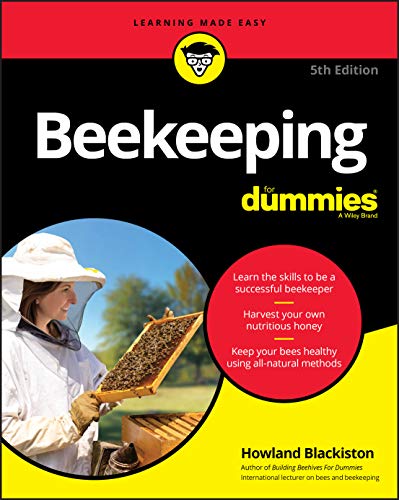
The most detailed step-by-step beginner book. Blackiston walks through every stage, from picking a hive site to overwintering, with checklists, a troubleshooting guide for pests and diseases, and a month-by-month calendar. See our full Beekeeping For Dummies review.
- Good: very thorough; great troubleshooting sections; easy to dip in and out of.
- Watch for: long; the Dummies format is not for everyone.
Storey’s Guide to Keeping Honey Bees, 2nd Edition, by Malcolm T. Sanford and Richard E. Bonney

A practical, no-nonsense manual from two experienced beekeepers and educators, covering equipment, colony management, honey production and health. It is well suited to hobbyists who want to understand why each task matters, not just how to do it.
- Good: practical and well organized; strong on colony management and honey production.
- Watch for: fewer photos than the Flottum book.
Beekeeping for Beginners, by Amber Bradshaw

A short, friendly introduction for people still deciding whether beekeeping is for them. It covers choosing bees and equipment, setting up a first hive and the basic seasonal jobs, without overwhelming detail.
- Good: quick and approachable; inexpensive; good gift for the curious.
- Watch for: you will outgrow it within the first season; pair it with a fuller guide.
Best reference books for your shelf
The Beekeeper’s Handbook, by Diana Sammataro and Alphonse Avitabile

The reference book experienced beekeepers keep on the shelf, published by Cornell University Press. It is organized as clear step-by-step procedures and flowcharts for everything from inspections and requeening to disease diagnosis. It is not a bedtime read, but it is the book you open when something goes wrong.
- Good: authoritative and comprehensive; excellent diagrams and decision charts.
- Watch for: dense for a complete beginner; best as a second book.
The Beekeeper’s Bible, by Richard A. Jones and Sharon Sweeney-Lynch

A large, beautifully illustrated book that combines the history and lore of bees, a practical beekeeping section, and dozens of recipes and projects using honey and beeswax. It makes a great gift for any beekeeper.
- Good: beautiful to browse; history, how-to and recipes in one volume.
- Watch for: the practical section is less detailed than a dedicated beginner guide.
Two older classics are worth knowing about. The Hive and the Honey Bee, from Dadant, is the long-standing technical textbook of North American beekeeping. The ABC and XYZ of Bee Culture, by A.I. Root and E.R. Root, began as an encyclopedia in the 1800s and went through many editions. Look for a recent edition from a bee supplier or a used bookshop; many copies sold online reprint the early 1900s text, which is of mostly historical interest now.
Best books on bee science and behavior
Honeybee Democracy, by Thomas D. Seeley

Cornell biologist Tom Seeley explains how a swarm of thousands of bees debates and chooses a new home, based on decades of field experiments. It reads like a detective story and will change how you see a swarm hanging in a tree.
- Good: fascinating, readable science; deepens your understanding of swarming.
- Watch for: not a how-to book.
The Lives of Bees, by Thomas D. Seeley

Seeley’s study of how honey bees live in the wild, in small, widely spaced tree-cavity colonies, and what that suggests for gentler, more bee-friendly beekeeping. Essential reading if you are interested in natural or treatment-light approaches.
- Good: thought-provoking; grounded in long-term research.
- Watch for: challenges some conventional practices; read it alongside a standard guide.
Buzz: The Nature and Necessity of Bees, by Thor Hanson

A lively natural history of bees of every kind, not just honey bees: how they evolved, why flowers and bees depend on each other, and why their decline matters. A great read for beekeepers and gardeners alike.
- Good: engaging writing; broad view of bee diversity and pollination.
- Watch for: no practical beekeeping advice.
Best books on mason bees and hive products
Mason Bee Revolution, by Jill Lightner and Dave Hunter

A guide to raising gentle, solitary mason bees, which are superb orchard and garden pollinators and need no hive, suit or smoker. It covers nesting tubes and houses, the yearly cycle, and harvesting and cleaning cocoons. Pair it with our mason bee house guide.
- Good: the go-to book on mason bees; easy entry to beekeeping without honey bees.
- Watch for: specific to solitary bees.
Beehive Alchemy, by Petra Ahnert

Projects and recipes using honey, beeswax, propolis and pollen: candles, soaps, lip balms, salves and more, with clear instructions. Ideal once you have wax and honey to spare.
- Good: lots of tested projects; good use for cappings wax.
- Watch for: not about managing bees.
How to choose a beekeeping book
- Check the edition. Beekeeping advice has changed, especially on varroa mite control. Buy the latest edition of any practical guide; the books above are current editions.
- Match the book to your region. Most popular guides are written for temperate North America. If you live somewhere very hot or very cold, pair a general book with advice from your local beekeeping club or state extension service.
- One beginner guide is enough. Read one cover to cover rather than skimming three. Then keep a reference like The Beekeeper’s Handbook for questions as they come up.
- Books plus people. No book replaces a mentor. Join a local club; most run beginner courses in late winter.
Frequently asked questions
What is the best beekeeping book for beginners?
The Backyard Beekeeper by Kim Flottum and Beekeeping For Dummies by Howland Blackiston are the two most recommended. Flottum’s book is more visual and concise; Blackiston’s is more detailed and step by step. Either one will carry you through your first year. We have a full Beekeeping For Dummies review.
When should I read a beekeeping book?
The winter before you get bees. That gives you time to learn the basics, order equipment and bees, and set up your hive before spring. See when to start a beehive.
Are old beekeeping books still useful?
For bee biology and history, yes. For practical management, especially pests and diseases, use a recent edition. Varroa mites only reached North America in the late 1980s, and treatment advice has changed a lot since.
Are there good free beekeeping resources?
Yes. University extension services publish free beekeeping guides, and many local clubs lend books from their libraries. A published book is still the easiest way to get the whole picture in one place.
Ready for the next step? See our guides to beehive starter kits, bee suits, beekeeping tools and where to buy bees.