Best Beehive Starter Kits for Beginners (2026)
Honey Garage is reader-supported. As an Amazon Associate we earn from qualifying purchases, at no extra cost to you. Read our affiliate disclosure.
A beehive starter kit is the fastest way to go from “I want bees” to a hive that is ready for them. A good kit gives you the woodenware, frames, and basic tools in one box, so you are not piecing together a hive from a dozen listings and hoping the parts fit.
The catch is that “starter kit” means very different things. Some are a single brood box with a smoker thrown in. Others include a bee suit, twenty tools and a queen excluder. A few are just the hive. This guide compares seven kits that are in stock right now, explains what each one actually includes, and lists the parts that almost every kit leaves out, so you know what else to budget for before your bees arrive.
One thing no kit includes: the bees. You order those separately, as a package or a nucleus colony, usually in winter for spring pickup. See where to buy bees before you order a hive, because local suppliers often sell out by February.
Our picks at a glance
- Best overall: BeeCastle 10-Frame Bee Hives and Supplies Starter Kit: hive, bee suit and a full tool set in one order.
- Best hive-only kit: Hoover Hives Original Beeswax Coated Beehive Kit: two deeps and a medium, so the hive can grow all season.
- Best two-box hive for the money: MayBee 10-Frame 2-Layer Beehive: a deep and a medium with frames for both.
- Best value with tools: Honey Lake 10-Frame Starter Kit: hive, smoker, gloves and a veil.
- Best 8-frame complete kit: BeeCastle 8-Frame Starter Kit: lighter boxes, same suit and tools as our top pick.
- Best budget 8-frame kit: MayBee 8-Frame Starter Kit: the cheapest complete hive-plus-tools kit we would buy.
- Best if you already have a hive: 31-Piece Beekeeping Tool Kit with Bee Suit: suit, smoker and tools, no woodenware.
Beehive starter kits compared
| Kit | Frame size | Boxes | Bee suit | Tools | Box assembly |
|---|---|---|---|---|---|
| BeeCastle 10-Frame Starter Kit | 10-frame | 1 deep | Jacket, pants, gloves | Smoker + 21 tools | Assembled |
| Hoover Hives Original Kit | 10-frame | 2 deep, 1 medium | No | No | Flat-pack, pre-drilled |
| MayBee 10-Frame 2-Layer | 10-frame | 1 deep, 1 medium | No | No | Quick setup |
| Honey Lake 10-Frame Starter Kit | 10-frame | 1 deep | Veil hat, gloves | Smoker + basic set | Assembled |
| BeeCastle 8-Frame Starter Kit | 8-frame | 1 deep | Jacket, pants, gloves | Smoker + 21 tools | Assembled |
| MayBee 8-Frame Starter Kit | 8-frame | 1 deep | Gloves only | Smoker + basic set | Assembled |
| 31-Piece Tool Kit with Suit | — | None | Suit with hood, gloves | Smoker + 30 pieces | — |
Frames in every kit arrive unassembled. Expect to spend an evening nailing frames together and snapping in the foundation sheets. It is easy, and a good way to learn how the parts of a hive fit together.
The 7 best beehive starter kits
1. BeeCastle 10-Frame Bee Hives and Supplies Starter Kit (best overall)
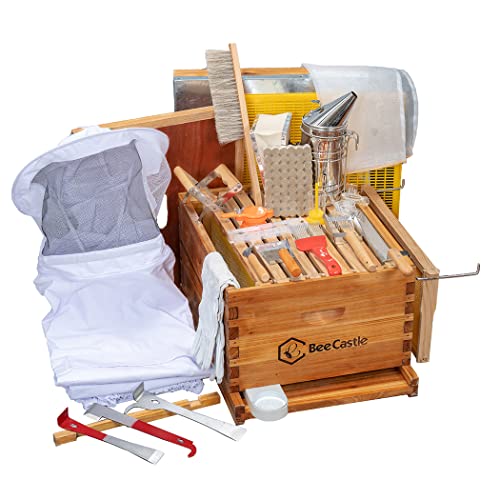
If you want one order that covers the hive, the protective gear and the tools, this is the kit to get. The deep brood box arrives assembled and dipped in beeswax, with a solid bottom board, telescoping top cover, inner cover, queen excluder and entrance reducer. You also get ten pine frames with beeswax-coated plastic foundation, a smoker, a frame holder, a tote bag and nineteen other tools, plus a beekeeping jacket, pants and leather gloves.
The boxes are cedar, which resists warping and rot better than the pine used in cheaper hives, and BeeCastle’s wood is FSC-certified. Because the wax coating seals the wood, you do not need to paint it.
- Good: genuinely complete for day one; assembled box; cedar construction; suit and gloves included.
- Watch for: only one deep box, so you will need a second deep or a honey super by early summer; the suit is one size, so check the measurements if you are very tall or broad.
2. Hoover Hives Original Beeswax Coated Beehive Kit (best hive-only kit)
Hoover Hives is one of the most-reviewed hive makers on Amazon, and this kit fixes the biggest weakness of most starter kits: it gives you room to grow. You get two deep brood boxes and one medium super, wooden frames and heavy wax-coated foundation, all beeswax coated. That is the standard setup most beekeepers run in their first year: two deeps for the colony and a medium for honey.
The boxes ship flat, with pre-drilled holes and screws, so allow an afternoon for assembly. There is no suit or tool set, which makes this the right pick if you want better woodenware and plan to choose your own bee suit and smoker. Hoover sells several variants, so check the exact parts list on the listing before you order.
- Good: three boxes, so no emergency box order mid-season; heavy wax coating; a long track record.
- Watch for: needs assembly; no tools or protective gear.
3. MayBee 10-Frame 2-Layer Beehive (best two-box hive for the money)
This MayBee hive gives you a deep brood box and a medium super, with ten deep frames and ten medium frames, all with beeswax-coated plastic foundation. It adds a queen excluder, a vented inner cover, a metal-topped telescoping cover, a removable bottom board and an entrance reducer. The boxes are wax-coated cedar with dovetail joints, and MayBee says the hive sets up in about half an hour.
You get two boxes for less than most single-box kits with tools. Pair it with a separate hive tool, smoker and veil and you have a complete setup that will last more than one season.
- Good: deep plus medium with frames for both; metal top cover; strong value.
- Watch for: no tools or suit; in cold climates you may still want a second deep for winter stores.
4. Honey Lake 10-Frame Starter Kit (best value with tools)
Honey Lake’s kit is the budget way into a full-size 10-frame hive with tools. The cedar deep box comes assembled, with dovetail joints, ten unassembled frames with foundation, a bottom board and an entrance reducer. The tool set covers the basics: smoker, gloves, uncapping tools and a honey gate. Instead of a full suit you get a hat with a 360° veil.
A veil and gloves are enough for many calm hives, but most beginners feel more confident in at least a jacket for their first inspections. Budget for a ventilated bee jacket if you choose this kit.
- Good: lowest price for a 10-frame hive plus tools; assembled cedar box.
- Watch for: veil only, no jacket; one deep box.
5. BeeCastle 8-Frame Starter Kit (best 8-frame complete kit)
This is our top pick in the narrower 8-frame size. You get the same package as the 10-frame BeeCastle: an assembled, wax-dipped cedar deep with bottom board, telescoping top, inner cover, queen excluder and entrance reducer, eight frames with foundation, a smoker and frame holder with nineteen more tools, and a jacket, pants and gloves.
An 8-frame box full of honey weighs noticeably less than a 10-frame box, which matters if lifting heavy boxes is a concern. Just remember that every box, frame and accessory you add later must also be 8-frame. See 8-frame vs 10-frame below.
- Good: complete kit in a lighter format; cedar; suit included.
- Watch for: 8-frame parts are less common at local suppliers; one deep box.
6. MayBee 8-Frame Starter Kit (best budget 8-frame kit)
The cheapest kit here that still gives you a complete hive and a working tool set. The assembled, wax-coated deep comes with eight frames and foundation, a solid bottom board, telescoping top cover, inner cover, queen excluder and entrance reducer. The tools include a smoker, frame holder, gloves, uncapping knife, bee brush, J-hook and L-hook hive tools and two feeders.
There is no suit or veil in the box, so add a veil at minimum. Even with one, the total usually comes in under the price of the fully kitted-out kits above.
- Good: low price; useful tool set including feeders; assembled box.
- Watch for: no protective clothing beyond gloves; one deep box.
7. 31-Piece Beekeeping Tool Kit with Bee Suit (best if you already have a hive)
If you already have woodenware, or you bought a hive-only kit like the Hoover or the MayBee 2-layer, this fills in everything else. It includes a breathable bee suit with a removable mesh hood, gloves, a smoker, frame holder, frame grip, hive tools, bee brush, queen cage, feeder, honey gate and filter bag, all in a tool bag.
- Good: suit and tools for less than buying them separately; pairs well with a hive-only kit.
- Watch for: multi-piece kits vary in tool quality; many beekeepers upgrade the smoker and hive tool after the first season.
What a beehive starter kit should include
A complete beginner setup has three parts: the hive, the protective gear and the tools. Use this checklist to see what a kit covers and what you still need.
- Hive: bottom board, entrance reducer, at least one deep brood box with frames and foundation, inner cover and telescoping top cover. A queen excluder is useful once you add a honey super. See parts of a beehive for what each piece does.
- Protective gear: a veil at the very least, plus gloves. A jacket or full suit makes the first few inspections far less stressful.
- Tools: a smoker, a hive tool and a bee brush. A frame grip and frame holder are nice to have.
What most kits leave out
- A second box. Most kits include one deep. A growing colony needs a second deep or a medium within a couple of months. The usual rule is to add a box when bees cover seven of the ten frames.
- A hive stand. Raising the hive keeps the bottom board dry, deters skunks and saves your back. See the best hive stands.
- A feeder. New colonies on fresh foundation need sugar syrup to build comb. A few kits include one; most don’t. See the best bee feeders.
- Varroa monitoring and treatment. Varroa mites are the leading cause of colony losses. Plan to check mite levels from your first summer. See the best varroa mite treatments.
- Smoker fuel. Pine needles or burlap work, or buy smoker fuel ready-made.
- The bees. A package or a nuc, ordered separately.
8-frame vs 10-frame: which size should you buy?
Both are Langstroth hives. The frames are the same length and depth, and the only difference is the width of the box. Once you choose, stick with it: 8-frame and 10-frame boxes do not stack on each other.
| 8-frame | 10-frame | |
|---|---|---|
| Box width | About 14 in | About 16 1/4 in |
| Weight of a full deep | Roughly 60–70 lb | Roughly 80–90 lb |
| Parts availability | Good online, patchy locally | Everywhere; the industry standard |
| Boxes needed | More, as the hive grows taller | Fewer |
| Best for | Anyone who wants lighter lifting | Most beginners; easiest to buy parts and nucs for |
If you are not sure, choose 10-frame. Nucs, extractors and local suppliers all assume it, and your mentor’s spare frames will fit. Our Langstroth beehive guide covers hive sizes and components in more detail.
Assembled or flat-pack? Wax-coated or painted?
Assembled boxes save an afternoon and remove any worry about getting the box square. Flat-pack kits, like the Hoover, cost less per box and are not hard to build: dovetail joints, pre-drilled holes and a screwdriver. Frames are unassembled in almost every kit. If you want to build your own, follow our guide to assembling a Langstroth beehive.
Beeswax-coated boxes are dipped in hot wax that soaks into the wood and protects it from moisture. They are ready to use and do not need paint. Bare pine boxes do need two coats of exterior paint on the outside surfaces only, never inside. Every kit in this guide is wax-coated. If you buy unfinished boxes, see the best paint for beehives.
What it costs to start beekeeping
A realistic first-year budget for one hive in the US:
- Starter kit: about $90–$170, depending on what is included.
- Second box and frames: about $40–$70, unless your kit already has one.
- Bees: a package or nuc typically costs $150–$250.
- Extras: hive stand, feeder, sugar and mite treatment, about $50–$100.
Many experienced beekeepers recommend starting with two hives rather than one. With two colonies you can compare them, spot a problem sooner and share a frame of brood if one colony loses its queen. If the budget allows, buy two of the same kit so every part is interchangeable.
When to buy your kit
Fall and winter are the best time to buy. Kits are easy to find, you have time to assemble and set up the hive, and you can read up before the season starts. A typical first-year timeline in most of the US:
- October–December: choose and order your kit, and read a good beginner book (Beekeeping for Dummies is a popular first read). Find a local beekeeping club.
- January–February: order your package or nuc. Assemble frames, then pick and prepare the hive site.
- April–May: install package bees or install a nuc, and feed syrup while the bees draw comb.
- Summer: inspect every 7–10 days, add boxes as the colony grows and start mite checks. Our hive inspection guide walks through each step.
See when to start a beehive for how the timing shifts in warmer and colder climates.
Frequently asked questions
What comes in a beehive starter kit?
At minimum, a bottom board, one deep brood box with frames and foundation, an inner cover and a top cover. Better kits add a queen excluder, entrance reducer, smoker, hive tool, gloves and a veil or suit. Check the listing carefully, because two kits with similar names can include very different parts.
Do beehive starter kits come with bees?
No. Kits sold on Amazon never include live bees. You buy a package or a nucleus colony separately from a bee supplier or a local beekeeper, usually ordered in winter for spring pickup. See where to buy bees.
Is one brood box enough?
For the first few weeks, yes. By early summer a healthy colony will need a second box, and in most of the US colonies overwinter in two deeps, or a deep and a medium, so they can store enough honey. Plan to buy a second box unless your kit already includes one.
Should a beginner buy an 8-frame or a 10-frame hive?
Most beginners do best with 10-frame, because it is the standard size and parts and nucs are easy to find. Choose 8-frame if lifting 80-plus-pound boxes would be a problem for you.
Do I need to paint a beeswax-coated hive?
No. The wax coating already protects the wood. You can paint the outside if you want a color, but it isn’t necessary. Never paint or wax-coat the inside surfaces yourself.
Is a Flow Hive a good starter kit?
A Flow Hive makes harvesting easier, but it costs several times more than the kits above and you still have to manage the colony, inspect brood frames and control mites. Most beginners are better off learning on a standard Langstroth. Read our Flow Hive review for the full picture.
How much does it cost to start beekeeping?
Expect roughly $350–$550 for one hive in the first year, including the kit, a second box, bees and basic extras. Later years cost far less, because the woodenware lasts for many seasons.
The bottom line
For most beginners, the BeeCastle 10-Frame Starter Kit is the simplest way to get everything in one order: an assembled cedar hive, a suit and a full tool set. If you would rather invest in more woodenware and choose your own gear, the Hoover Hives Original Kit gives you three boxes, so the colony has room to grow all season. On a tight budget, the Honey Lake 10-Frame or MayBee 8-Frame kits get you started for less. Just plan for a second box, a feeder and mite control before summer.
Ready for the next step? Browse our guides to beekeeping tools and beekeeping supplies.