Bee Anatomy: The Parts of a Honey Bee Explained
Honey Garage is reader-supported. As an Amazon Associate we earn from qualifying purchases, at no extra cost to you. Read our affiliate disclosure.
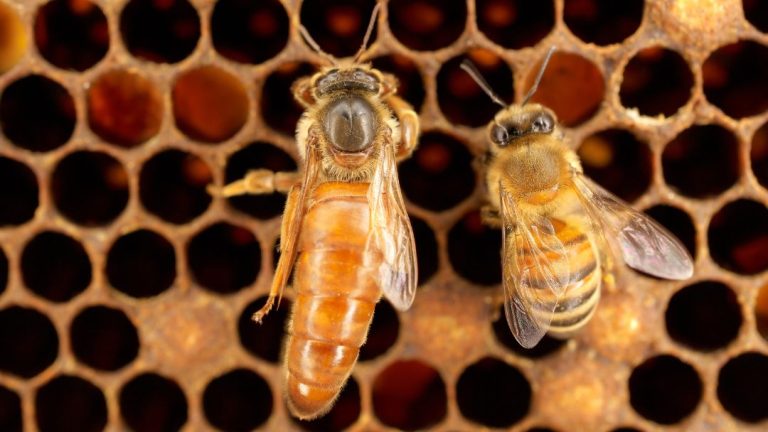
A honey bee’s body has three main parts: the head, which carries the eyes, antennae and mouthparts; the thorax, which carries the two pairs of wings and three pairs of legs; and the abdomen, which holds the honey stomach, the wax and scent glands and, in females, the stinger. Like all insects, the bee wears its skeleton on the outside, a hard exoskeleton covered in branched hairs that pick up pollen.
Knowing the parts is useful at the hive. It helps you tell a queen from a drone, read a pollen load, and understand why a sting keeps pumping venom after the bee has gone. Here is each part in turn.
The head
Compound eyes and ocelli
The two large compound eyes on the sides of the head are made of thousands of tiny units called ommatidia, each seeing a small piece of the scene. A worker has roughly 5,000–7,000 per eye, depending on the source, and a drone has far more, around 8,000–10,000. Bees see ultraviolet, blue and green light but not red, and they are very good at detecting movement and the pattern of polarized light in the sky, which helps them navigate.
On top of the head sit three small simple eyes called ocelli, arranged in a triangle. They do not form images. They sense light intensity and help the bee stay level in flight and judge the time of day.
Antennae
The two jointed antennae are the bee’s nose and fingertips. They carry thousands of sensory receptors for smell, touch, taste, humidity and vibration. Bees use them to find flowers, recognize nestmates by scent, and follow the waggle dance in the dark hive. Female antennae have 12 segments; drones have 13.
Mandibles
The mandibles are a pair of jaws on either side of the mouth. Workers use them to chew and shape wax, clean cells, carry debris and dead bees out of the hive, manipulate pollen and bite intruders. Glands at their base produce secretions used in royal jelly and, in the queen, the queen pheromone.
Proboscis
The proboscis is the bee’s drinking straw, a folding tongue that extends to lap up nectar, water and honey. When not in use it folds back under the head. Workers have a longer proboscis than queens or drones because they are the ones feeding from flowers.
The thorax
The thorax is the bee’s engine room. It is packed with flight muscles and carries every leg and wing.
Two pairs of wings and the hamuli
Honey bees have four wings: a larger front pair and a smaller hind pair. In flight, a row of tiny hooks called hamuli, usually around 20 along the front edge of each hind wing, catches a fold on the rear edge of the front wing. This locks each pair together so they beat as a single surface, over 200 times a second. The flight muscles do not attach directly to the wings; they flex the whole thorax, which moves the wings.
The same muscles can shiver without moving the wings. That is how bees generate heat to warm brood and keep the winter cluster alive.
Three pairs of legs
Each leg has several segments and ends in claws and a sticky pad, so bees can walk on rough bark and smooth glass. Each pair also has a special tool:
- Front legs: the antenna cleaner. A notch lined with stiff hairs, closed by a small spur, sits on each front leg. The bee pulls an antenna through it to comb off pollen and dust.
- Middle legs: the spur. A spine at the base of the middle leg helps pry pollen pellets loose and clean the wings.
- Hind legs: the pollen basket. The outer face of each hind leg has a smooth, slightly hollow area fringed by long curved hairs, called the corbicula. Workers brush pollen off their bodies, moisten it with nectar, press it into place with a comb and press on the leg, and fly home with two packed pellets. Propolis travels the same way.
The pellet color tells you which plants your bees are working. Our guide to pollen load colors helps you match them.
The abdomen
The abdomen is made of overlapping plates joined by flexible membranes, so it can stretch when full and pump air when the bee breathes. It connects to the thorax through a narrow waist.
Wax glands
Workers have four pairs of wax glands on the underside of the abdomen. They are most active in bees around two to three weeks old. The wax comes out as thin, clear flakes, which the bee picks off with her legs and chews into shape with her mandibles to build comb.
Nasonov gland
Near the tip of the abdomen, on the upper side, is the Nasonov gland. A worker exposes it by bending the tip of her abdomen down and fans her wings to spread a lemony scent. It says “home is here” and guides other bees to the entrance, a swarm cluster, or a new nest site. You often see bees doing this at the entrance after an inspection.
Stinger and barbs
The stinger is a modified egg-laying tube, so only females have one. A worker’s stinger has backward-pointing barbs. In the elastic skin of a mammal they catch, and when the bee pulls away, the stinger, venom sac and muscles tear out with it and keep pumping venom. The worker dies. An alarm pheromone released at the sting site marks the target for other bees, which is why you should scrape a sting out quickly and move away. See our beekeeper’s guide to bee stings.
Honey stomach
The honey stomach, or crop, is an expandable sac in front of the true stomach. Foragers fill it with nectar or water and carry it home. A valve between the crop and the digestive stomach lets the bee keep her load separate and feed herself only what she needs. Back at the hive she passes the nectar to house bees, who start turning it into honey. Here is how bees make nectar into honey.
Inside the bee: the main internal systems
- Open circulatory system. Bees have no arteries or veins. A long tube along the back, the dorsal vessel, pumps a fluid called hemolymph forward toward the head, and it then washes freely around the organs. Hemolymph carries nutrients and waste, but not much oxygen.
- Spiracles and tracheae. Oxygen arrives by a separate route. Air enters through small openings called spiracles along the sides of the thorax and abdomen and travels through a branching network of tubes (tracheae) and air sacs straight to the tissues. The tracheal mite lives in the large tracheae of the thorax.
- Hypopharyngeal glands. These glands in the head of young nurse bees, most active at roughly one to two weeks old, produce the protein-rich food fed to larvae. Mixed with secretions from the mandibular glands, it forms royal jelly, which queen larvae receive throughout their development. More in our article on royal jelly.
- Nervous system. A small brain plus a chain of nerve clusters along the body. Despite its size, the bee brain handles navigation, learning colors and scents, and decoding dances.
Honey bee body parts and their functions
| Body part | Location | Function |
|---|---|---|
| Compound eyes | Head | Vision, movement detection, navigation by polarized light |
| Ocelli (3) | Head | Sense light intensity; help with flight stability |
| Antennae | Head | Smell, touch, taste, humidity and vibration |
| Mandibles | Head | Chew wax, clean, carry, defend |
| Proboscis | Head | Drink nectar, water and honey; share food |
| Hypopharyngeal glands | Head | Brood food and royal jelly |
| Wings and hamuli | Thorax | Flight, fanning, heat regulation |
| Antenna cleaner | Thorax (front legs) | Groom the antennae |
| Pollen basket (corbicula) | Thorax (hind legs) | Carry pollen and propolis |
| Honey stomach | Abdomen | Carry nectar and water |
| Wax glands | Abdomen (underside) | Produce beeswax for comb |
| Nasonov gland | Abdomen (tip, upper side) | Orientation scent |
| Stinger | Abdomen (tip) | Defense; egg-laying tube in origin |
| Spiracles and tracheae | Thorax and abdomen | Breathing |
Queen, worker and drone: how their anatomy differs
| Feature | Queen | Worker | Drone |
|---|---|---|---|
| Body shape | Longest; long, tapering abdomen that extends well past the wings | Smallest | Bulky and blunt-ended; wings cover the abdomen |
| Eyes | Smaller, set at the sides | Medium, set at the sides | Very large; meet at the top of the head |
| Antennae | 12 segments | 12 segments | 13 segments |
| Stinger | Smooth, curved; can sting repeatedly but rarely does | Barbed; usually lost in mammals | None |
| Pollen baskets | No | Yes | No |
| Wax glands | No | Yes | No |
| Hypopharyngeal glands | Undeveloped | Well developed in nurse bees | None |
| Reproductive organs | Fully developed ovaries and a sperm store (spermatheca) | Undeveloped ovaries | Male reproductive organs; dies after mating |
These differences follow from each bee’s job. The worker is built as a tool kit for foraging, building and nursing. The queen is built to lay eggs, and the drone to find a queen in flight, which is why his eyes are so large. For more on each, see the worker bee, the queen bee and the drone bee.
Frequently asked questions
What are the three main body parts of a bee?
The head, the thorax and the abdomen. The head handles the senses and feeding, the thorax handles movement, and the abdomen holds digestion, the glands and the stinger.
How many eyes does a bee have?
Five. There are two large compound eyes on the sides of the head and three small ocelli on top. The compound eyes form images; the ocelli mainly sense light.
How many legs and wings does a bee have?
Six legs and four wings, all attached to the thorax. The front and hind wing on each side hook together with the hamuli, so in flight they work as two wings.
Do bees have a heart?
Yes, of a kind. The dorsal vessel running along the back acts as a heart, pumping hemolymph toward the head. From there it flows loosely through the body, because bees have an open circulatory system with no veins or arteries.
Why do honey bees die after they sting?
A worker’s stinger is barbed. In thick, elastic skin like ours, the barbs anchor it, and when the bee flies off the stinger and venom sac tear away from her abdomen. The injury kills her. When stinging another insect, she can usually pull the stinger back out.