30 Surprising Facts About Bees
Honey Garage is reader-supported. As an Amazon Associate we earn from qualifying purchases, at no extra cost to you. Read our affiliate disclosure.
Bees live in highly organized colonies, give each other directions by dancing, see colors we cannot and make honey that keeps for years. Here are 30 surprising facts about bees, mostly the honey bee, the species beekeepers know best. Every one is backed by bee research, and each gets a short explanation.
If you want the bigger picture of what bees do for crops, wildlife and our food supply, read why bees are important. This page is just the interesting stuff.
Facts about the colony
- A colony can hold 60,000 bees. A strong honey bee colony in summer typically has somewhere between 20,000 and 60,000 bees.
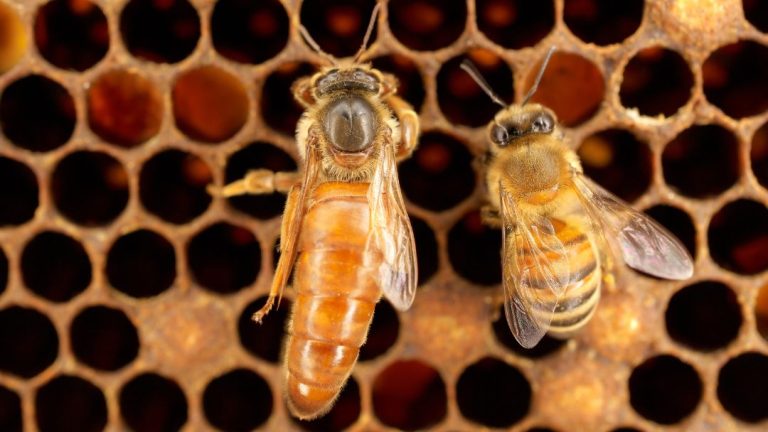
- Almost every bee you see is female. Worker bees are all female. Male bees, called drones, make up only a small part of the colony and only in spring and summer.
- Workers change jobs as they age. A young worker starts by cleaning cells, then feeds larvae, builds comb and guards the entrance. Only in her last couple of weeks does she leave to forage. Our guide to the worker bee covers each stage.
- A summer worker lives about six weeks. She works herself out in five or six weeks. Bees raised in autumn are built differently and can live four to six months to carry the colony through winter.
- Drones cannot sting and do not collect food. Their only job is to mate with a queen from another colony. In autumn, when food runs short, the workers push the remaining drones out of the hive.
- Bees run their own central heating. The colony keeps its brood nest at 93–95 °F (34–35 °C). In winter, honey bees do not hibernate; they form a tight cluster and shiver their flight muscles to make heat, burning stored honey as fuel.
Facts about the queen
- Queens are made, not born. Any fertilized egg can become a queen or a worker. The difference is diet: a future queen is raised in a large cell and fed royal jelly throughout her development.
- The queen develops fastest. From egg to adult takes about 16 days for a queen, 21 days for a worker and 24 days for a drone.
- She mates with a dozen or more drones. A young queen flies out to mate with roughly 12 to 20 drones, high in the air at spots called drone congregation areas. Drones die after mating.
- She mates only at the start of her life. Her mating flights happen in her first few weeks. She stores up to about 6 million sperm in an organ called the spermatheca and uses it for the rest of her life, which can be several years.
- She can lay about 1,500 eggs a day. At the peak of the season a good queen lays around that many, roughly her own body weight in eggs every day.
- She decides whether each egg is male or female. A fertilized egg becomes a female (a worker or a queen); an unfertilized egg becomes a drone. That means a drone has a mother but no father.
- Her scent holds the colony together. The queen gives off pheromones that the workers spread through the hive. If she dies, the colony notices within hours and starts raising a replacement. More in our guide to the role of the queen bee.
Facts about flight and navigation
- Their wings beat about 230 times a second. That speed is what makes the familiar hum. Honey bees use short, fast strokes rather than long sweeping ones.
- Bees fly at around 15 mph. An unloaded worker flies at roughly 15–20 mph; carrying nectar or pollen, she slows to about 12 mph.
- They forage miles from home. Most foraging happens within about two miles of the hive, but bees will fly five miles or more when food is scarce.
- Bees give directions by dancing. A forager who finds good flowers performs the waggle dance on the comb. The angle of her waggle run from vertical shows the direction of the food relative to the sun, and the length of the run tells the others how far away it is.
- The dance won a Nobel Prize. Karl von Frisch, who decoded the waggle dance, shared the 1973 Nobel Prize in Physiology or Medicine for his work on animal behavior.
- Bees can navigate on cloudy days. They can see polarized light, so a patch of blue sky is enough to tell them where the sun is. They also memorize landmarks around the hive.
Facts about honey
- One bee makes about 1/12 of a teaspoon of honey. That is the usual estimate for a worker’s whole lifetime. Every jar is the work of thousands of bees.
- Honey is mostly dried nectar. Nectar starts at roughly 70–80% water. Bees add enzymes and fan it until it is down to about 18% water, then seal it with wax. Here is how bees turn nectar into honey, step by step.
- Honey is very hard to spoil. Its low water content and natural acidity stop most microbes from growing, so sealed honey keeps for years. If it turns solid, it has only crystallized, and gentle warming makes it liquid again.
- Bees make their own building material. Workers produce beeswax from glands on the underside of the abdomen, as small white flakes. They chew the flakes and shape them into six-sided cells, the shape that stores the most honey for the least wax.
Facts about bee senses
- Bees have five eyes. Two large compound eyes on the sides of the head do most of the seeing. Three small simple eyes on top, called ocelli, help with light levels and orientation.
- They see ultraviolet but not red. Many flowers have ultraviolet patterns, invisible to us, that guide bees to the nectar. Red looks dark to a bee, which is why bee flowers are mostly blue, purple, yellow and white.
- Their sense of smell is exceptional. The honey bee genome has about 170 odorant receptor genes, compared with 62 in the fruit fly. Bees use smell to find flowers, recognize nestmates and read pheromone signals.
- Bees can learn to recognize human faces. In lab experiments, honey bees were trained to pick out a particular face from a set of photos, and they remembered it days later. We cover the research in can honey bees recognize faces.
Facts about bee stings
- Only females sting. The stinger is a modified egg-laying organ, which is why drones do not have one. The queen’s stinger is smooth, and she saves it for rival queens.
- A worker usually dies after stinging a person. Her stinger is barbed, so it catches in thick mammal skin and tears away from her body, along with the venom sac. She can sting other insects and pull free. Scrape or pull the stinger out quickly; how fast you remove it matters more than how.
- A sting calls for backup. A stinging bee releases an alarm pheromone that smells a lot like bananas. It marks the target and tells nearby bees to join in, which is why beekeepers use smoke to mask it. Our guide to bee stings covers treatment and when to see a doctor.
Frequently asked questions
How many types of bees are there?
About 20,000 bee species have been described worldwide, and roughly 4,000 live in North America. Most are solitary bees that nest alone. Only a handful of species make honey in useful amounts.
Do all bees make honey?
No. Honey bees store large amounts of honey, bumble bees store small amounts of a honey-like nectar, and stingless bees in the tropics make honey too. Most bee species, including mason bees and other solitary bees, make none.
Do bees sleep?
Yes. Researchers have seen worker bees rest in a sleep-like state, with their antennae drooping and muscles relaxed. Foragers mostly sleep at night, while young house bees nap in short bouts through the day and night.
How long do bees live?
A worker honey bee lives about five to six weeks in summer and four to six months over winter. Drones live a few weeks to a few months. A queen can live several years, although many beekeepers replace queens every year or two.
Can a bee sting more than once?
A worker honey bee stinging a person usually cannot, because the barbed stinger stays in the skin. Bumble bees, most solitary bees, wasps and queen honey bees have smoother stingers and can sting more than once.
The best way to see these facts for yourself is to keep a hive. You can watch the waggle dance on a frame in your hands. If that sounds appealing, our comparison of beehive starter kits is a good first step.