Bee Pollen Benefits: What It Is and What the Evidence Says
Honey Garage is reader-supported. As an Amazon Associate we earn from qualifying purchases, at no extra cost to you. Read our affiliate disclosure.
Bee pollen is flower pollen that honey bees have packed into small granules to carry home as food. It contains protein, sugars, fats, vitamins, minerals and plant antioxidants, which is why it is sold as a “superfood”. The honest summary of bee pollen benefits is this: lab and animal studies look promising, but good human trials are few and small, so most health claims are not proven.
Below is what bee pollen is, how it gets from the flower to the jar, what is in it, what the research does and does not show, and who should avoid it.
What bee pollen is
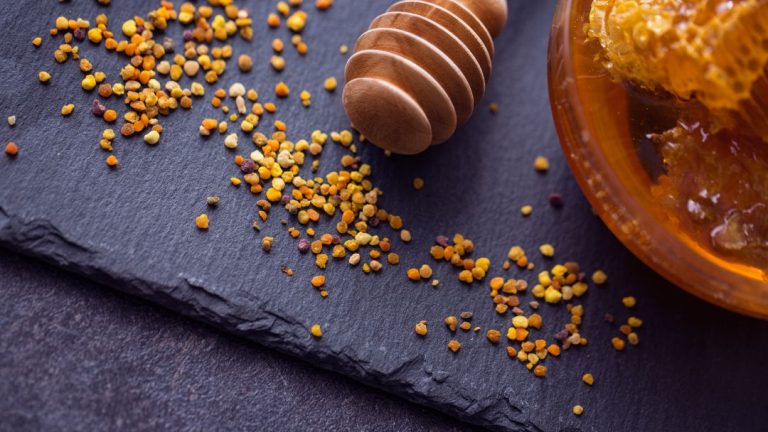
Pollen is the powdery male reproductive material of flowering plants. On its own it is loose dust. A forager bee brushes it off her body, moistens it with a little nectar and saliva, and presses it into the “pollen baskets” (corbiculae) on her hind legs. The result is a pellet, and those pellets are what gets sold as bee pollen.
Each pellet usually comes from a single plant species, because a forager tends to stick to one kind of flower per trip. That is why a handful of bee pollen is a mix of colors: yellow, orange, cream, green, grey, even purple, depending on what was blooming. Our colour guide to pollen loads shows which plants give which shades.
For the colony, pollen is the only natural source of protein and fat. Nurse bees eat it to produce the food they feed to larvae. A single colony gathers somewhere around 15 to 55 kg (roughly 30 to 120 lb) of pollen a year, depending on its size and the forage around it. Read more about why and how bees forage.
How beekeepers harvest it
Beekeepers collect pollen with a pollen trap: a grid fitted at or near the hive entrance with holes just big enough for a worker to squeeze through. As she pushes through, some of the pellets are knocked off her legs and fall through a screen into a drawer that the bees cannot reach.
- Efficiency varies. Studies report traps catching anywhere from about 10% to 60% of incoming pollen, depending on design and colony.
- Empty it often. Fresh pollen is moist and goes mouldy quickly. Most beekeepers empty the drawer every day or two and freeze or dry the contents straight away.
- Do not trap nonstop. Taking pollen reduces brood rearing. Only strong colonies should be trapped, and many beekeepers run traps for short periods or alternate them between hives.
For a step-by-step method, see how to harvest pollen from your bees, and for equipment, our roundup of pollen traps.
What is in bee pollen
Composition swings a lot with plant source, region and season, so any single number on a label is an average. Published reviews give ranges like these for dried bee pollen:
| Component | Typical range (dry weight) | Notes |
|---|---|---|
| Carbohydrates | About 13–55% | Mostly sugars from the nectar used to pack the pellets |
| Protein | About 10–40% | Contains all the essential amino acids, though amounts vary by plant |
| Fats (lipids) | About 1–13% | Includes essential fatty acids and sterols |
| Fibre | Up to about 20% | Much of it is the tough outer pollen wall |
| Minerals and vitamins | Small amounts | Potassium, magnesium, iron, zinc, B vitamins, some vitamin C and E |
| Phenolic compounds | Variable | Flavonoids and other plant antioxidants |
Keep the serving size in mind. A teaspoon of granules weighs only a few grams, so it adds a modest amount of protein and micronutrients to your day. It is a nutrient-dense food, not a replacement for a varied diet.
One more caveat: a meaningful share of the pollen grain’s contents sits behind a hard outer shell that human digestion does not fully break down, so not everything on a nutrition table is absorbed.
Bee pollen benefits: what the research shows
Here is where marketing and science part ways. Hundreds of papers have been published on bee pollen, but most are test-tube or animal studies. Those can show that something is worth investigating. They cannot show that eating a spoonful will do the same in a person.
| Claimed benefit | Main type of evidence | Honest verdict |
|---|---|---|
| Antioxidant activity | Lab assays of pollen extracts | Real in the test tube; effect in the body unclear |
| Anti-inflammatory effects | Lab and rodent studies | Promising, not shown in human trials |
| Antimicrobial action | Lab studies | Extracts inhibit some bacteria in a dish; no clinical use established |
| Liver protection | Rodent studies | Early animal data only |
| Cholesterol and blood sugar | Mostly animal studies | Not established in people |
| Menopause symptoms | A few small human studies | Some improvement reported, but trials are small and often lack a proper placebo group |
| Athletic performance | Small human trials | No convincing benefit found |
| Hay fever relief | Little to no trial data | Unproven, and pollen itself can trigger allergic reactions |
| Weight loss | No good evidence | Unproven; some “bee pollen” diet pills have been found spiked with drugs |
That last row deserves emphasis. The US FDA has warned consumers about several weight-loss products sold as bee pollen that contained undeclared prescription drugs, including sibutramine, which was withdrawn from the market over heart risks. If a bee pollen product promises dramatic weight loss, walk away.
So what can you fairly say? Bee pollen is a nutritious food with a lot of interesting chemistry, and researchers are right to keep studying it. It has not been shown to treat or prevent any disease in people. If you are considering it for a health condition, talk to your doctor first.
Side effects and allergy risk
For most healthy adults, small amounts of bee pollen seem to be well tolerated. The serious risk is allergy.
- Allergic reactions, including anaphylaxis. Doctors have published case reports of people who developed hives, facial swelling, trouble breathing, vomiting and low blood pressure within about an hour of eating bee pollen, some needing emergency epinephrine. People with pollen allergies (hay fever), asthma, or a history of reactions to bee products are at higher risk.
- Pregnancy and breastfeeding. There is no reliable safety data, and medical references generally advise avoiding bee pollen during pregnancy and while breastfeeding.
- Warfarin and other blood thinners. A published case describes a patient on warfarin whose INR, previously stable, rose to 7.1 after about a month of taking a teaspoon of bee pollen granules twice a day. If you take a blood thinner, do not start bee pollen without talking to your doctor or pharmacist.
- Stomach upset. Some people get mild digestive symptoms, especially at larger amounts.
Being stung by bees without a problem does not mean you are safe with bee pollen. Sting allergy is a reaction to venom; bee pollen reactions are usually to the plant pollens themselves. The two are different.
How to take bee pollen
There is no official recommended dose. If your doctor agrees it is fine for you, a cautious approach looks like this:
- Test first. Start with one or two granules and wait a day to see how you react. Stop immediately at any itching, swelling, wheezing or rash.
- Build up slowly. Increase gradually over a week or two. Many people settle on around a teaspoon a day.
- Eat it with food. Sprinkle granules on yogurt, oatmeal, cereal or salads, or blend them into a smoothie. The taste is floral, slightly sweet and a little bitter, and it varies by batch.
- Skip the heat. Baking or cooking at high temperatures degrades some of the vitamins and antioxidants, so add it after cooking.
Bee pollen is sold as granules, powders, capsules and tablets. If you want to buy some, our guide to the best bee pollen supplements covers what to look for.
How to store bee pollen
Moisture is the enemy. Freshly trapped pollen holds roughly 20–30% water, enough for mould and yeast to grow within days at room temperature. Commercial dried pollen is taken down to well under 10% moisture so it keeps.
- Fresh (undried) pollen: freeze it. It keeps well for months in the freezer.
- Dried granules: store in an airtight glass jar in a cool, dark cupboard, or in the fridge for longer keeping. Keep the lid tight so the granules do not pick up moisture.
- Check before eating: discard pollen that smells musty or sour, has clumped into a damp mass, or shows fuzz.
If you keep bees, you have probably seen a related product inside the hive: pollen that the bees have packed into cells and preserved. That is bee bread, and it is not the same thing as trapped pollen. We explain the difference in what is bee bread. For other hive products, see our guides to royal jelly and the rest of our harvesting section.
Frequently asked questions
What does bee pollen do for your body?
It supplies small amounts of protein, carbohydrates, fats, vitamins, minerals and plant antioxidants. Beyond that basic nutrition, specific effects such as reduced inflammation or better cholesterol have mostly been seen in lab and animal studies, not proven in people.
Is it safe to take bee pollen every day?
For most healthy adults who are not allergic, small daily amounts appear to be well tolerated in the short term. Long-term safety has not been well studied. Avoid it if you are pregnant, breastfeeding, allergic to pollen or bee products, or on warfarin, and check with your doctor if you have any health condition.
Does bee pollen help with allergies?
There is no good clinical evidence that eating bee pollen relieves hay fever. It can do the opposite: people with pollen allergies are the group most likely to react badly to it, sometimes severely. Talk to an allergist rather than experimenting on your own.
Who should not take bee pollen?
People with pollen allergies, asthma, or past reactions to bee products; pregnant or breastfeeding women; and anyone taking warfarin or another blood thinner. Children should not be given it without a doctor’s advice.
Is bee pollen vegan?
Most vegans do not consider it vegan, because it is collected by bees and removed from the hive by trapping. Some plant-based eaters are comfortable with it; it depends on your personal definition.
What does bee pollen taste like?
Floral and slightly sweet, with a powdery, sometimes bitter finish. The flavor changes with the flowers the bees visited, so two jars from different regions or seasons can taste quite different.